freelancers who rely on scattered apps, manual processes, and memory to manage their business lose hours daily to administrative friction. Productivity tools automate repetitive work, centralize information, and eliminate the context switching that drains focus and delays client deliverables. The right toolkit transforms chaos into a streamlined system where technology handles logistics while you focus on the skilled work clients pay for. Lire aussi : Best AI tools for freelancers scale your business in 2026 Lire aussi : Best free ai tools for freelancers
Building a productivity stack isn’t about collecting every trending app—it’s about connecting a few powerful tools that work together seamlessly. Time tracking feeds invoicing, project managers sync with calendars, email filters surface urgent client messages, and automation ties everything together. Freelancers who invest time selecting and configuring the right tools gain hours back every week, which compounds into hundreds of hours annually available for billable work or business growth.
If managing your calendar is the bottleneck, check out the top AI scheduling and calendar tools that automate booking, reminders, and time-blocking for freelancers.
Time tracking: capture every billable minute
freelancers billing by thehour leave significant revenue on the table when they forget to log tasks or underestimate time spent on client revisions. Manual time tracking fails because you forget to start timers, leave them running through lunch, or skip logging entirely when jumping between quick tasks. The solution is software that automates capture and organizes data by client or project.
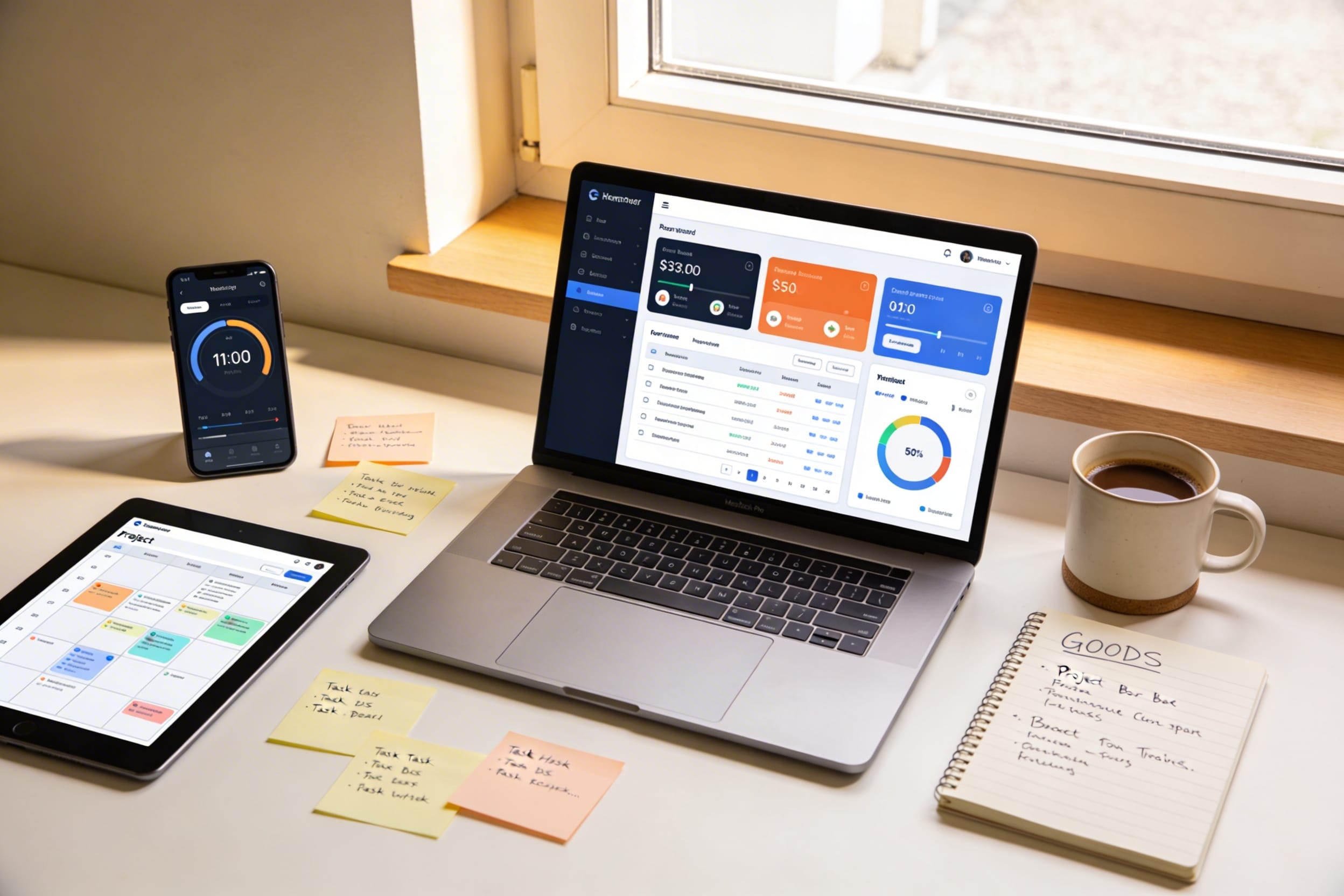
Toggl Track offers one-click timers that run in the background across desktop, mobile, and browser extensions. Start a timer, label it with a project name, and let it run while you work. Reports break down your week by client and show exactly where hours went, making invoicing straightforward. Harvest goes further by combining time tracking with invoicing in one platform, converting logged hours into client bills with a few clicks.
For freelancers who resist manualtimers entirely, RescueTime runs silently in the background and automatically categorizes apps and websites you use throughout the day. You get passive logs showing how much time went to email, design tools, research, or distractions without remembering to click start and stop. Timely takes a middle approach with memory tracking that captures everything you do on your computer and lets you convert activities into tracked time entries with a single drag.
If your work involves creating visuals or brand assets, our guide to AI design tools for freelancers covers the best options for every creative need.
The key is consistent labeling. Generic time logs without client or project names become useless data. Tag every entry correctly from the start, distinguish billable from non-billable time clearly, and review weekly logs to spot patterns in how you allocate hours. These insights reveal which clients consume disproportionate time relative to what they pay and where non-billable admin work piles up, driving smarter pricing and scheduling decisions that integrate smoothly with automated time tracking systems.
Project management: organize multiple clients without chaos
juggling several clients, dozens of tasks, and shifting deadlines without a central system leads to missed deliverables and constant stress. Your brain shouldn’t serve as your task database—externalizing commitments into project management software designed for solo workers creates clarity about what’s due today versus what can wait.
Trello organizes work into visual boards where cards represent tasks and move across lists as work progresses. Create separate boards for each client or one master board with color-coded labels distinguishing projects. Asana offers multiple views of the same data—list view for linear tasks, board view for kanban workflows, calendar view for deadline planning. The platform’s free tier covers unlimited tasks and projects, making it powerful enough to scale with your workload.
Notion blends project management with note-taking and documentation in one flexible workspace. Build custom dashboards with kanban boards for active tasks, databases for client information, and embedded documents for project briefs. ClickUp packs enterprise-level features into a solo-worker-friendly interface, including task dependencies, automations, and built-in time tracking that eliminates tool switching.
The setup matters as much as the tool choice. Create separate projects for each client to simplify filtering, use recurring tasks for regular obligations like weekly check-ins or monthly invoices, and build templates for workflows you repeat with different clients. Review your system daily and update task statuses as work progresses—abandoned project tools help nobody. Give clients view-only access to their boards so they see progress in real time without you writing status update emails.
Invoicing and payments: get paid faster with less effort
chasing unpaid invoices and manually copying hours into billing templates wastes time better spent on paid work. Invoice and payment automation generates bills instantly from tracked hours, sends reminders automatically, and accepts payments through embedded links that let clients pay with one click.
FreshBooks connects to time trackers so logged hours flow directly into invoice line items. Automated reminders go out before and after due dates without you writing awkward follow-up emails. QuickBooks handles invoicing alongside full accounting features like expense categorization and tax preparation, ideal for freelancers who want billing and bookkeeping in one platform. Wave offers completely free invoicing and accounting with revenue coming from optional payment processing fees.
The workflow improvements multiply when tools connect. Time logs become invoice drafts automatically, payment reminders send themselves on schedules you configure once, and clients pay through embedded buttons that post transactions directly to your books. What used to consume 30 minutes per invoice now takes 30 seconds of review before sending.
Define payment terms upfront in contracts and on every invoice—net 15, net 30, or due upon receipt. Vague expectations lead to delays. Send invoices immediately upon completing milestones rather than waiting until month-end or when you need cash. Regular invoicing trains clients to expect and process bills promptly. Review which clients consistently pay on time and which run late, using that data to adjust deposit requirements or payment terms for future engagements.
Email management:stay responsive without
drowning
freelancers average 90 emails daily, half of which don’t need immediate attention. Without structure, your inbox becomes a chaotic mix of urgent client requests, routine updates, promotional noise, and spam. Email management tools filter clutter, surface important messages, and reduce the cognitive load of constant triage.
Superhuman rebuilds email around speed with keyboard shortcuts that eliminate mouse clicking. The split inbox automatically sorts messages into important, other, and newsletters based on sender patterns. SaneBox works with your existing email provider and moves unimportant messages into a separate folder you review once daily, keeping client emails front and center. Spark offers smart grouping that surfaces urgent threads and quick reply templates for common responses.
Gmail’s native features deliver substantial improvement at no cost. Priority inbox sorts automatically, filters route messages to labels based on sender or subject, scheduled send delivers emails during business hours regardless of when you write them, and canned responses save template text for frequently sent messages.
The habits matter more than the tools. Check email at specific times—morning, midday, late afternoon—rather than leaving your inbox open all day. Process messages in batches, responding to everything under two minutes immediately and converting longer tasks to your project system. Set communication expectations with clients upfront, stating your typical response time in contracts. This protects you from pressure to respond instantly while maintaining professional reliability.
Content creation: write and edit with confidence
freelance writers juggling research, grammar checks, and client revisions need tools that catch errors before clients see them and speed up the editing process. Grammar mistakes, unclear phrasing, and plagiarism damage your reputation and trigger revision cycles that delay payment. Content creation tools for writers bundle editing, style analysis, and fact-checking into interfaces that improve quality without slowing you down.
Grammarly checks spelling, grammar, punctuation, and style in real time across any platform—Google Docs, WordPress, email, or native writing apps. The tone detector ensures your writing matches client brand voices, while clarity suggestions identify wordy phrases and passive voice. ProWritingAid combines grammar checking with deep style reports that analyze overused words, readability, pacing, and sentence length variation. The tool identifies writing habits specific to your patterns and tracks improvement over time.
Hemingway Editor highlights dense, complicated writing and suggests simpler alternatives. The readability score shows what grade level your writing targets, useful when clients specify audience sophistication. Copyscape checks whether your content appears elsewhere on the web, essential for avoiding plagiarism and protecting clients from duplicate content penalties. Otter.ai transcribes interviews and calls automatically, turning spoken research into searchable text without manual typing.
Build templates for each content type you produce regularly—blog posts, case studies, white papers—to eliminate blank-page paralysis. Separate research from writing by dedicating specific time blocks to each activity, then close research tabs and write from notes to avoid constant context switching. Run editing tools after completing first drafts rather than during writing to maintain creative flow. Use tools as advisors that reveal patterns in your work, not dictators of every word choice. The goal is polished drafts that pass client review on the first submission, shortening your payment cycle and building a reputation for quality.
Workflow automation: eliminate repetitive tasks
copying data between tools, sending the same update emails, and manually moving files between platforms steals hours weekly that could go toward billable work. Workflow automation tools link your apps so actions in one trigger updates in others automatically—time logs become invoice line items, form submissions land in your project manager, and follow-ups send themselves without your involvement.
Zapier connects over 6,000 apps through workflows called Zaps. A new email triggers a task creation in Asana, a completed calendar booking adds an event to Google Calendar, a finished time entry creates an invoice line item in FreshBooks. Make offers more powerful automation with visual flowcharts showing exactly how data moves between apps, including error handling and conditional branching. Airtable’s built-in automations trigger when database records change, sending emails to clients when projects complete or creating invoices when status fields update.
Start by automating high-frequency tasks where you perform identical steps multiple times daily. Connect core tools first—time tracker to invoicing, form submissions to CRM, project manager to calendar. Test automations with real client data before deploying them in production to verify data maps correctly and conditional logic routes information appropriately. Monitor execution logs weekly to catch failures before they create silent gaps in your workflow.
Common freelancer automations include lead-to-client pipelines where contact form submissions automatically populate your CRM and send welcome emails, time-tracking-to-invoicing flows that convert logged hours into draft bills, and project kickoff sequences that create folders, boards, and calendar events from signed contracts. Document how each automation works so future troubleshooting doesn’t require reverse-engineering. Track time saved and errors prevented to measure ROI—recovered hours translate directly to additional billable capacity or business development time.
Conclusion
productivity tools transform freelance work from reactive chaos into a controlled system where technology handles logistics automatically. The right toolkit—time tracking that feeds invoicing, project management that surfaces priorities, email filters that protect focus, content tools that ensure quality, and automation that eliminates repetitive work—multiplies your capacity without proportionally increasing your hours. Start by connecting your most-used tools, automate your highest-frequency tasks, and refine your system based on actual time savings. Freelancers who build efficient productivity stacks gain competitive advantages through faster turnaround times, higher quality deliverables, and the capacity to serve more clients profitably. The automation infrastructure you build today becomes the foundation for scaling your business tomorrow without burning out or sacrificing the flexibility that made freelancing attractive in the first place.
Related articles: workflow automation tools for freelancers — smart time tracking tools — AI assistants for project management
Frequently Asked Questions
What is business automation for freelancers?
Business automation for freelancers means using software to handle repetitive tasks automatically — sending invoices, following up with clients, scheduling social posts, onboarding new clients, and managing contracts. Tools like Zapier, Make.com, and HoneyBook connect your apps and trigger actions without manual input.
How much time can automation save a freelancer?
Studies show freelancers can save 10–20 hours per week by automating routine tasks. Common time-savers include automated invoicing (saves ~2h/week), client onboarding sequences (saves ~3h/client), and social media scheduling (saves ~4h/week).
Is automation difficult to set up for non-technical freelancers?
No. Modern no-code automation platforms like Zapier and Make.com use drag-and-drop interfaces with thousands of pre-built templates. Most freelancers can set up their first automation in under 30 minutes with no coding required.
What should I automate first in my freelance business?
Start with your highest-volume repetitive tasks: invoice generation and follow-ups, client onboarding emails, appointment scheduling, and social media posting. These four areas typically deliver the fastest ROI and biggest time savings.