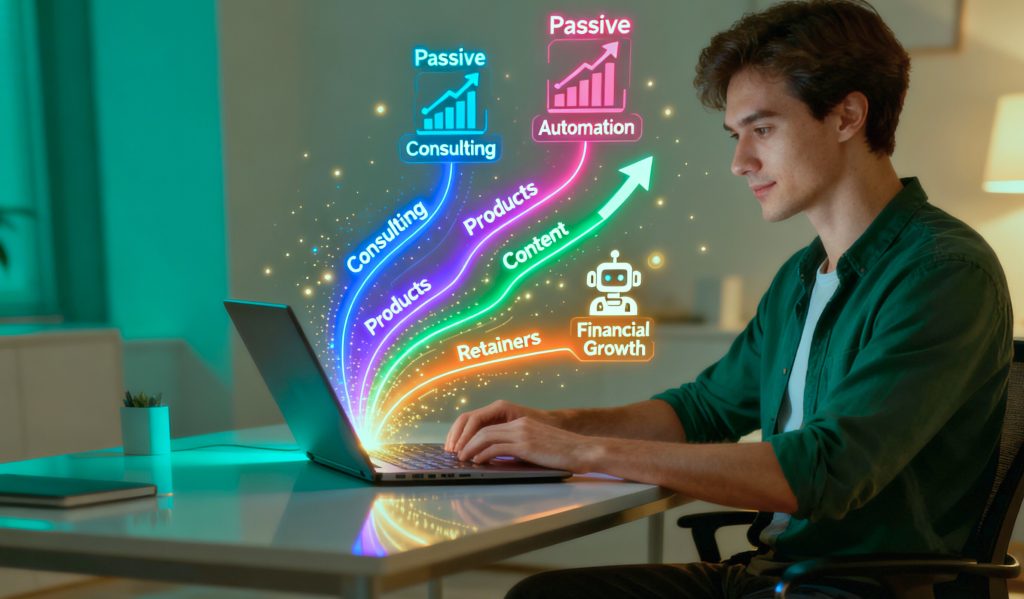
This shift breaks down old barriers. It lets one person compete with established players. The key is using smart tools that handle complex tasks for you.
My goal here is simple. I want to share what I’ve learned from testing these solutions. You’ll get real-world insights on saving time and growing your business.
This guide will walk you through the practical steps. You’ll see how to implement these strategies in your own work. The opportunity for independent creators is massive today.
This shift breaks down old barriers. It lets one person compete with established players. The key is using smart tools that handle complex tasks for you.
My goal here is simple. I want to share what I’ve learned from testing these solutions. You’ll get real-world insights on saving time and growing your business.
This guide will walk you through the practical steps. You’ll see how to implement these strategies in your own work. The opportunity for independent creators is massive today.
Key Takeaways
- The combination of AI and no-code platforms is transforming how solo entrepreneurs operate.
- Traditional barriers like needing coding skills or a large team are now removed.
- These technologies enable significant savings in both time and operational costs.
- Solo founders can now realistically compete with funded startups and larger companies.
- Practical, real-world case studies provide a blueprint for successful implementation.
- Understanding this trend is crucial for anyone building a business in the current digital environment.
AI no-code is the combination of artificial intelligence with visual development platforms, allowing non-programmers to build applications, automations and digital products by describing what they want or assembling visual blocks. For solopreneurs in 2026, this pairing removes the two historical barriers to building software: engineering cost and technical skill. Typical outputs include client portals, internal tools, automated workflows, chatbots and full web applications, built in days rather than months. The leading platforms combine visual builders (Bubble, Softr, Glide), automation engines (Make, Zapier, n8n) and AI generation layers that write the logic, content or code behind the scenes. Costs run from free tiers to roughly 50 dollars per month per platform – against 10,000 dollars or more for equivalent custom development. The realistic limitation: no-code suits standard business applications; products requiring unusual performance, scale or integrations still need engineers.
Unpacking the AI and No-Code Revolution
I remember the first time I saw someone without a tech background launch a real app. It challenged everything I thought was possible. This moment was my entry point into a much larger shift.
Reflecting on My Early Encounters with AI Tools
My start was humble. I used chatbots for brainstorming and editing text. It felt like a clever helper, not a business engine. That changed when I saw the output. These tools could draft plans, analyze data, and even write code snippets. The potential for saving time became crystal clear.The Evolution of No-Code Platforms Over Time
I learned about builders investing thousands of hours into platforms like Bubble. They came from non-technical fields but shipped real software. This dedication showed that while barriers fell, mastery still required effort. The platforms themselves evolved rapidly. They grew from simple page builders into powerful environments. This progress, combined with new intelligent assistants, created a powerful synergy for people who build.Empowering Solo Founders with AI-Driven Tools
My perspective shifted entirely after seeing a 60-minute task shrink to 60 seconds. This is the core of modern empowerment for independent builders. It moves beyond simple convenience. It fundamentally alters what one person can achieve for their business.How I Cut Hours From Daily Tasks
Christina Puder’s experience was a revelation. She runs a service finding jobs for clients with specific criteria. Her manual search used to eat 60 minutes daily per client. After implementing smart tools, it takes one minute. This 98% reduction isn’t just about speed. It unlocked massive scale for her operation. I learned the key is targeting repetitive, pattern-based tasks.
This efficiency changes the model. You can serve more people without working more time. For a solo founder, that is transformative power.
This 98% reduction isn’t just about speed. It unlocked massive scale for her operation. I learned the key is targeting repetitive, pattern-based tasks.
This efficiency changes the model. You can serve more people without working more time. For a solo founder, that is transformative power.
| Common Task | Manual Time | Automated Time | Time Saved | Primary Impact |
|---|---|---|---|---|
| Targeted Job Search | 60 minutes | 1 minute | 59 minutes | Increased client capacity |
| Content Drafting | 90 minutes | 10 minutes | 80 minutes | Faster content cycle |
| Data Review & Summary | 120 minutes | 5 minutes | 115 minutes | Quicker strategic decisions |
Understanding No-Code AI Solopreneurs
A decade of side work culminated in a bold move for one career coach in Madrid. Christina Puder spent ten years coaching product managers on the side. She built a full client list without a technical background or outside funding. In 2025, she decided to run her business full-time. She was bootstrapped and knew hiring employees was too costly. Her story defines a new archetype. I’ve seen many founders like her. They are resourceful and focused on moving fast with lean operations. These builders don’t start with a goal to use fancy technology. They adopt smart platforms to solve real problems. It’s a practical, problem-first mindset. For Christina, automation tackled a specific bottleneck. This approach changes the game. Technical skill is no longer a barrier to entry. A No-Code AI Solopreneurs uses tools to compete with larger companies. They build independently, without big teams or capital. This model represents a fundamental shift. Individual founders can now scale effectively. The key is leveraging automation for clear operational gains. The rise of the No-Code AI Solopreneurs proves one thing. You don’t need a tech team to build a serious venture today.Launch and Learn: Building a Website with AI Assistance
My own attempts at website design were marked by wasted hours and disappointing results. This struggle is a shared experience for many independent founders before they discover a better path.My Journey from Traditional Design to AI Automation
Christina Puder’s story perfectly captures this arc. She first tried an old website builder and failed. Next, she hired a part-time designer and engineer, but progress was slow. While waiting, she tried a free account with Lovable, an AI coding assistant. She simply added basic information about her desired design. The platform then built her entire landing page automatically. This was a stark contrast to her past effort. She had previously invested 30 to 40 hours trying to build her site. The result was, in her words, “ugly and clunky.”Lessons Learned from Using Lovable and Similar Tools
The efficiency of this tool was remarkable. With just five free credits a day, she could make consistent progress. She learned a crucial lesson about credit optimization early on. Bundling multiple change requests into one message used only one credit. A complete landing page with three sections and brand colors required about 2.5 credits. The most important takeaway is the paradigm shift. Building for the web transforms from a technical skill into a communication task. Clearly describing what you want leads to professional results.Saving Time and Streamlining Business Operations
Streamlining operations reached a new benchmark when I documented a job search task shrinking from an hour to a minute. This case study shows how to transform daily workflows for any service business.Transforming Tasks: From 60 Minutes to 1 Minute
Christina Puder ran a service finding jobs for clients with specific criteria. Manually, this consumed 60 minutes daily for each person. She admitted she really didn’t think such a drastic cut was possible. Implementing an intelligent assistant changed everything. The new process took just one minute. This 98% reduction works because the tool excels at pattern recognition and systematic matching. The gain isn’t a one-time event. It compounds every single day across all clients. The strategic insight is clear. Target repetitive tasks that swallow disproportionate time relative to their complexity. This automation fundamentally alters service economics. A solo operator can manage a much larger client base. It turns a constraint into a powerful scaling advantage.Transitioning from Casual AI Use to Full-Time Adoption
The path to fully integrating smart technology into a business often begins with simple curiosity. Many founders start by using a helper for basic tasks like writing or research. Christina Puder’s story is a perfect example. She initially saw ChatGPT as just a casual tool for ideas. She didn’t have a tech background, so she never imagined it could power her entire operation.Embracing AI Without a Technical Background
Her breakthrough came after building a website with an intelligent assistant. This tangible success opened her eyes. She realized these platforms could transform her internal systems too. I’ve learned that non-technical backgrounds can be an advantage. People without coding experience approach these tools with fresh eyes. They aren’t limited by preconceived notions of what’s difficult. The transition from casual user to full-time adopter happens organically. It’s not a strategic plan. It emerges when founders see a tool solve a real problem better than old methods. What defines the environment today is the lowered barrier. You don’t need to understand how the technology works. You just need to communicate what you want it to do.Leveraging AI for Creative and Design Innovations
The barrier between having a great idea and executing it professionally has nearly vanished. I’ve seen this most clearly in creative fields, where vision no longer requires years of technical training. Christina Puder’s experience building her website was a prime example. She provided basic design preferences, and the platform generated a complete, polished landing page. This turns high-concept ideas into professional visual content instantly. Another fascinating project is pianolabs.ai. This tool understands musical context. A user can describe a desired sound, like “transition from a dark beginning to a dream-like section.” The system then recommends fitting chords and structures. The philosophy here is crucial. The goal is not to replace human creativity. It’s to empower people by bridging the gap between their imagination and their technical skill. The tool acts as a collaborative partner. This approach eliminates a major historical bottleneck. Creative vision often exceeded a solo creator’s execution capability. Now, that limitation is fading. Individuals can produce work that truly matches their internal design.Balancing Automation with Hands-On Expertise
The true test of any tool comes when it hits a wall, and you must decide whether to push through or call for help. I’ve learned that even the most powerful platforms have moments where they falter. Christina Puder’s journey taught me this balance. She sometimes spent 40 credits trying to fix a single bug. Her approach was pragmatic. She would ask the system to remove the feature and start fresh rather than dig deeper.When to Rely on AI and When to Involve a Human Expert
A specific logo sizing issue on her site proved stubborn. Repeated prompts failed to make them uniform. This showed a clear limitation. She eventually paid her part-time engineer to fix it. This wasn’t a failure. It was a smart allocation of resources. “Every once in a while,” she notes, human expertise is needed for specific fixes. The key skill is developing judgment. You must know when persistence will pay off and when it’s time to bring in a person. This comes from experience. For creative work and technical development, this balance is crucial. Maintaining relationships with experts provides a safety net. It allows for more confident experimentation with automated tools. The goal isn’t to choose one over the other. It’s to use automation for the bulk of work. Then, reserve human insight for moments where it dramatically accelerates problem-solving. This strategic combination is what builds resilient content and operations.Exploring No-Code Courses and Community Learning
The most surprising lesson I’ve learned isn’t about technology, but about the power of community. Platforms like NoCodeLife offer practical case studies for non-technical builders. Their structured course material provides a clear path forward. This is vital for people transitioning from traditional jobs.Building Skillsets and a Network as a Solopreneur
I saw this with the pianolabs.ai builder. They share their entire process on X because working privately led to quitting. This public building creates accountability. It also builds a network of peers facing similar challenges. A good course delivers technical content. But community engagement tackles the motivation problem many face.| Learning Method | Pace | Accountability | Network Access | Completion Rate |
|---|---|---|---|---|
| Self-Guided Learning | Variable | Low | Minimal | Often Low |
| Structured Course & Community | Steady | High | Strong | Significantly Higher |
Anticipating Today’s Tools and Tomorrow’s Breakthroughs
The arrival of platforms like Cursor and Vercel signals a new era for independent builders. Since 2022, the pace of innovation has accelerated dramatically. New and powerful tools launch almost daily, changing what’s possible. What excites me is the trajectory these platforms reveal. Each new version pushes boundaries further. Concepts like “vibe coding” translate intent directly into functional software. The exploration of intelligent agents represents the next frontier. These systems move beyond simple automation. They handle complex, judgment-based tasks that once required a human. The key question is how far non-technical creators can push software creation. The answer expands with every platform update. For sustainable growth, balance using today’s proven tools with watching for the next version. Breakthroughs often come from solving real builder pain points. Tomorrow’s innovations will make creation more intuitive and powerful. The future is built by those who start with today’s platforms.Real-Life Social Proof from Business Insider and Fellow Solopreneurs
When a major publication like Business Insider spotlights a solo founder’s journey, it sends a powerful signal. It validates the entire approach for skeptical entrepreneurs. Christina Puder’s feature in “The AI-Powered Solopreneur” series is a prime example. This coverage shows mainstream media now sees these strategies as legitimate. They are not just experimental novelties.Insights Gleaned from Industry Pioneers and My Own Experience
Her trajectory from zero to a full client roster over ten years is concrete evidence. It proves sustainable growth is achievable. Transitioning full-time in 2025 marks a real milestone. The economics are remarkably accessible. Her $20 monthly subscription provides 100 credits, plus daily free ones. This minimal overhead is a fraction of traditional development costs. Pioneers reveal crucial implementation details. Understanding credit mechanics and tier transitions helps others maximize value. These insights are gold for anyone building a business. This kind of validation creates tangible opportunities. It builds credibility that directly drives sales. Featured stories can boost email list growth and attract new sales leads. My research confirms the value of transparent accounts. Sharing both successes and challenges sets realistic expectations. It provides the best version of a roadmap for others. For driving sales and growing an email list, this social proof is invaluable. It turns a personal story into a powerful email and marketing asset.Wrapping Up My Journey with AI and No-Code Innovations
The convergence of intelligent automation and accessible platforms marks a turning point. It has democratized the ability to build a serious venture, removing old barriers. Success here doesn’t demand technical skill. It requires curiosity and a willingness to experiment with new approaches to content, design, and building for the web. These tools amplify human capability rather than replace it. They let one person produce professional-level content and products. The most effective founders embrace iteration and share their progress openly. We are still in the early stages. Each new version of these platforms expands what’s possible. The synergy between automation and implementation is transformative. I’m more optimistic than ever about the opportunities for dedicated, independent builders.Related articles: how autonomous AI agents transform freelance work — AI business ideas for freelancers — AI business model for freelancers
Frequently Asked Questions
What is business automation for freelancers?
Business automation for freelancers means using software to handle repetitive tasks automatically — sending invoices, following up with clients, scheduling social posts, onboarding new clients, and managing contracts. Tools like Zapier, Make.com, and HoneyBook connect your apps and trigger actions without manual input.
How much time can automation save a freelancer?
Studies show freelancers can save 10–20 hours per week by automating routine tasks. Common time-savers include automated invoicing (saves ~2h/week), client onboarding sequences (saves ~3h/client), and social media scheduling (saves ~4h/week).
Is automation difficult to set up for non-technical freelancers?
No. Modern no-code automation platforms like Zapier and Make.com use drag-and-drop interfaces with thousands of pre-built templates. Most freelancers can set up their first automation in under 30 minutes with no coding required.
What should I automate first in my freelance business?
Start with your highest-volume repetitive tasks: invoice generation and follow-ups, client onboarding emails, appointment scheduling, and social media posting. These four areas typically deliver the fastest ROI and biggest time savings.