Email remains one of the highest ROI marketing channels when executed well. Poor execution produces inbox clutter that damages your brand. AI email marketing tools optimize every element from send timing to subject lines to content personalization. These systems test variations automatically, learn from results, and improve performance continuously. Businesses using intelligent email automation typically see open rates double and conversion rates triple compared to traditional batch-and-blast approaches. The technology handles complexity while marketers focus on strategy and creative direction. Email automation forms a cornerstone of effective customer acquisition, as detailed in our guide to growth hacking with AI strategies.
The paradox of email marketing is that it delivers exceptional returns while most email campaigns perform poorly. Average open rates hover around 20 percent and click rates below 3 percent. This mediocrity stems from treating email as a broadcast medium rather than a conversation channel. AI transforms email into individualized communication that feels personal even at massive scale.
Why traditional email campaigns underperform
Batch-and-blast campaigns send identical messages to entire lists simultaneously. This approach ignores that different recipients have different interests, preferences, and optimal engagement times. A message perfect for one segment feels irrelevant to another. Generic content gets ignored by most recipients because nothing distinguishes it from the dozens of other promotional emails they receive daily.
Static segmentation improves on mass blasts but remains crude. Dividing lists by industry, role, or past behavior creates segments that still contain substantial diversity. A segment of marketing managers includes people at different company sizes, with varying budgets, facing distinct challenges, and preferring different communication styles. Treating them identically misses opportunities for deeper relevance.
Manual optimization requires extensive testing and analysis that most teams lack resources to execute consistently. Testing subject lines, send times, and content variations demands setting up experiments, collecting data, analyzing results, and implementing changes. This process takes weeks per test, limiting how quickly you can improve performance.
List fatigue sets in when you email too frequently with content that does not deliver value. Subscribers who initially welcomed your messages start ignoring them or worse, marking them as spam. This degradation happens gradually as relevance declines through generic messaging and poor timing.
AI-powered send time optimization
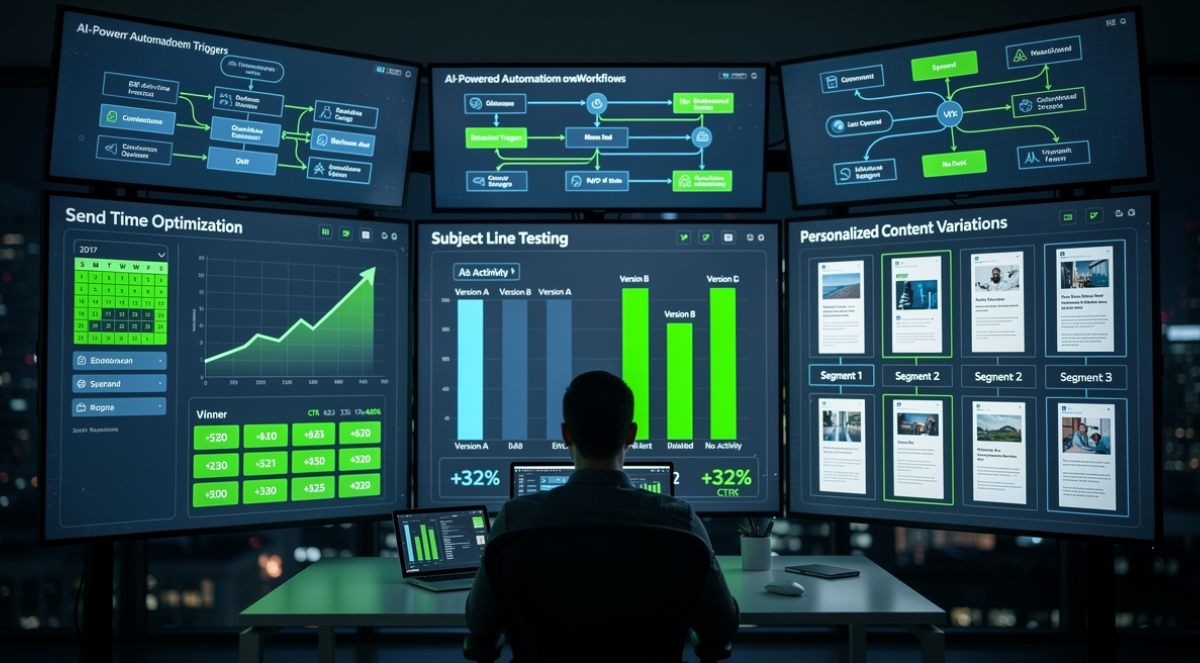
When you send email matters as much as what you send. AI analyzes each recipient’s historical engagement patterns to determine their optimal send time. Some people check email first thing in the morning. Others engage more during lunch or evening hours. Weekend patterns differ from weekdays. The AI learns these individual preferences and schedules delivery accordingly.
The improvement from send time optimization alone typically increases open rates by 15 to 30 percent with zero content changes. You simply reach people when they are most likely to see and engage with your message rather than when it is convenient for you to send.
Time zone awareness represents the most basic version of send time optimization. Sending at 10am in each recipient’s local timezone ensures you hit their inbox during working hours rather than the middle of the night. AI goes further by learning not just timezone but individual behavioral patterns.
Engagement velocity analysis predicts not just when people check email but when they take action. Some recipients open immediately but click hours later. Others delay opening but click as soon as they read. The AI optimizes for your desired outcome, whether that is opens, clicks, or conversions.
Platforms like Seventh Sense, Mailchimp’s send time optimization, and HubSpot’s AI features handle this automatically. You schedule campaigns in your preferred timezone and the system staggers actual delivery for optimal recipient timing. This happens invisibly without additional work from your team.
Subject line intelligence that drives opens
Subject lines determine whether recipients open your email or ignore it. AI tools test thousands of variations to identify what works for different audience segments. The systems learn which words, lengths, emoji usage, and personalization approaches perform best.
Predictive subject line scoring evaluates your proposed subject line before sending. The AI compares it against successful patterns in your historical data and benchmark databases. It predicts likely open rate and suggests improvements. This feedback helps you avoid underperforming subject lines before wasting them on your list.
Dynamic subject line generation creates individualized lines for different recipients. Rather than one subject line for everyone, the AI assembles variations from components that resonate with different segments. A recipient interested in ROI sees financial framing. Someone focused on ease of implementation sees simplicity messaging. Both receive relevant angles on the same core message.
Emoji usage optimization varies by audience. Some segments respond positively to emoji in subject lines while others find them unprofessional. The AI learns which recipients engage more with emoji and includes them selectively rather than applying one rule to everyone.
Length optimization balances information conveyance with mobile display constraints. Longer subject lines provide more context but get truncated on mobile devices. The AI determines optimal length for your specific audience based on their device usage patterns and engagement history.
Content personalization beyond first names
Most email personalization stops at inserting recipient names in the greeting. This surface-level personalization feels token rather than meaningful. True personalization adapts entire message content to recipient interests, behavior, and stage in the customer journey.
Dynamic content blocks change based on recipient data. Product recommendations show items related to past purchases or browsing behavior. Content sections highlight topics the recipient has engaged with previously. Case studies feature companies similar to the recipient’s organization. This granular personalization makes every email feel custom-crafted.
Behavioral triggers fire emails based on specific recipient actions. Abandoned cart reminders, post-purchase follow-ups, re-engagement campaigns for inactive subscribers, and content download confirmations all respond to individual behavior. These triggered messages convert at much higher rates than broadcast campaigns because they address specific situations.
Journey stage personalization adjusts messaging based on where recipients are in the buying process. Early-stage prospects receive educational content. Mid-stage leads get product comparisons and feature deep-dives. Late-stage opportunities receive offers and urgency messaging. This alignment between message and readiness dramatically improves conversion rates.
AI copywriting assistants generate personalized variations of your core message at scale. You provide the essential information and specify personalization variables. The AI produces numerous variations maintaining your brand voice while addressing different segment needs. This automation makes extensive personalization practical where manual creation would be impossible.
List segmentation that improves with every send
Traditional segmentation requires manually defining rules and criteria. You decide that company size, industry, and past purchase behavior matter, then create segments based on these variables. This static approach misses patterns not obvious to humans and fails to adapt as subscriber behavior changes.
AI-powered segmentation discovers natural groupings in your subscriber data automatically. The algorithms identify which combinations of attributes and behaviors correlate with engagement and conversion. These discovered segments often reveal opportunities you would never find through manual analysis.
Predictive segmentation creates groups based on predicted future behavior rather than just past actions. The AI identifies subscribers likely to churn, those ready to purchase, and those needing nurturing. You can target each predictive segment with appropriate messaging rather than treating all equally.
Micro-segmentation creates extremely narrow groups for hyper-personalized campaigns. Rather than broad segments of thousands, you work with dozens of smaller segments each receiving highly relevant content. AI makes this granular approach manageable by automating segment creation, content variation, and performance tracking.
Segment performance tracking reveals which groups deliver the best engagement and revenue. The AI analyzes ROI by segment, helping you identify where to concentrate efforts and budget. Low-value segments might receive less frequent communication or automated nurturing rather than expensive custom campaigns.
Optimizing email cadence and frequency
How often you email subscribers significantly impacts engagement and list health. Too frequent and you annoy people into unsubscribing. Too rare and subscribers forget who you are. The optimal frequency varies dramatically by subscriber, making this impossible to solve with universal rules.
AI frequency optimization determines ideal email cadence for each subscriber based on their engagement patterns. Active subscribers who open and click every message can receive more frequent communication. Less engaged subscribers get reduced frequency to prevent fatigue. This individualization maximizes both engagement and list retention.
Engagement-based throttling automatically reduces sending to subscribers showing declining interest. If someone stops opening your emails, the system spaces them further apart rather than continuing aggressive frequency. This gentler approach often re-engages subscribers who would otherwise unsubscribe or mark messages as spam.
Reactivation campaigns use AI to identify optimal timing and messaging for dormant subscribers. The system detects when someone has disengaged and triggers specialized win-back sequences. These campaigns offer special value, ask for preference updates, or simply remind subscribers why they joined initially.
Preference learning happens implicitly through behavior analysis when explicit preference centers go unused. Most subscribers never update email preferences manually. AI infers preferences by analyzing which topics, formats, and frequencies generate engagement versus ignore patterns for each individual.
A/B testing on autopilot
Manual A/B testing requires planning experiments, splitting audiences, collecting results, declaring winners, and implementing changes. This process takes days or weeks per test, limiting optimization velocity. AI automates this entire cycle, running continuous experiments that improve performance constantly.
Multi-armed bandit algorithms test variations while simultaneously optimizing for results. Rather than traditional A/B tests that split traffic evenly between variants, these algorithms quickly identify winners and shift more traffic to better-performing options. You get optimization benefits faster without waiting for tests to reach statistical significance.
Multi-variate testing examines combinations of elements simultaneously. Instead of testing subject line versus send time versus content in separate sequential experiments, AI tests all combinations at once. This approach finds synergies between elements that sequential testing misses.
Automatic winner implementation applies successful variations without human intervention. When the algorithm identifies a clear winner, it applies that variation to all future sends automatically. You review performance reports rather than monitoring tests and manually implementing changes.
Platform recommendations for email AI include ActiveCampaign for small to mid-sized businesses wanting robust automation at reasonable prices. Klaviyo for e-commerce companies needing shopping behavior integration. HubSpot for businesses already using their CRM and marketing tools. Iterable for mobile-first companies with app and push notification needs alongside email.
Measuring what matters in AI email marketing
Vanity metrics like open rates and click rates provide incomplete pictures of email effectiveness. Revenue attribution shows which emails actually drive purchases and how much. This business outcome metric justifies email investment far better than engagement statistics.
Conversion rate by email type reveals which campaign categories deliver results. Promotional emails, educational content, product announcements, and event invitations all serve different purposes. Understanding performance by type helps optimize your email mix rather than treating all campaigns identically.
List growth rate tracking ensures your acquisition efforts exceed natural attrition. Subscribers naturally churn through address changes, disinterest, and other factors. Your growth rate must overcome this decline to maintain list size. AI helps by optimizing signup forms and lead magnets for maximum conversion.
Deliverability monitoring prevents your emails from landing in spam folders where they never reach subscribers. Track bounce rates, spam complaint rates, and sender reputation scores. AI tools identify deliverability issues early and suggest corrective actions before damage becomes severe.
For strategies on converting the engaged subscribers you cultivate through email into actual customers, see our guide on retargeting with AI to win back lost customers and maximize revenue from your audience.