Small businesses are actively seeking AI consulting services for small business growth but struggle to find experts who can translate hype into concrete results. By packaging strategic audits, implementation roadmaps and ongoing advisory, freelancers can move from simple execution to high-value partnership. This approach fits perfectly within new economic models powered by AI for freelancers that prioritize leverage, positioning and scalable value.

Most small business owners feel the pressure to adopt automation and smarter systems. They read headlines about competitors cutting costs or scaling faster. They see tools advertised everywhere. But they lack clarity on where to start, which tools solve real problems, and how to implement without breaking existing workflows.
This gap creates opportunity. Small businesses will pay premium rates to someone who can assess their operations, identify high-impact improvements, and guide implementation without technical jargon or unnecessary complexity. They want a trusted advisor who speaks their language and delivers measurable outcomes.
The consulting market for small businesses differs from enterprise consulting. Budgets are tighter but decision cycles are faster. You deal directly with owners who care about ROI and immediate impact. Projects move quickly when properly scoped. A three-month engagement can generate $15,000 to $35,000 depending on scope and your positioning.
Positioning Yourself as an AI Consultant
Generic consultants compete on price. Specialists command premiums. The difference comes down to clear positioning and demonstrated expertise in solving specific problems for specific audiences.
Choose a vertical or problem space you understand deeply. E-commerce operations. Service business automation. Content production workflows. Customer support systems. The narrower your focus, the easier it becomes to communicate value and attract ideal clients.
Build credibility through case studies and documented results. Even if you start with one successful project, document the process, the outcome, and the client’s feedback. Publish this as a detailed case study on your site. Use it in proposals. Reference it in conversations. Proof matters more than promises.
Your positioning statement should communicate who you help, what problem you solve, and the outcome they can expect. Something like “I help e-commerce brands automate their customer support to reduce response time by 60% while cutting support costs” beats “I’m an AI consultant” by orders of magnitude.
Core AI Consulting Service Models
The most successful freelance consultants package their expertise into clear service models rather than selling ambiguous “consulting hours.” Three models work particularly well for small business clients.
Strategic audits provide immediate value in a compressed timeframe. You assess current operations, identify automation opportunities, prioritize by ROI, and deliver a roadmap. This typically runs two to four weeks and prices between $3,000 and $8,000. Clients get clarity and direction without committing to full implementation.
Implementation packages combine strategy with execution. You design the system, select tools, configure workflows, train the team, and hand off a working solution. These projects run two to four months and price between $12,000 and $40,000 depending on complexity. Clients get results without needing to figure out technical details themselves.
Ongoing advisory retainers provide continuous optimization and strategic guidance. After implementation, clients often want regular check-ins to refine systems, troubleshoot issues, and identify new opportunities. Monthly retainers of $2,000 to $6,000 provide predictable income while keeping you close to the business as it evolves.
Pricing for Value Instead of Hours
Hourly billing undermines consulting value. The faster and better you work, the less you earn. Project-based and value-based pricing align incentives correctly.
For strategic work, price based on the decisions your insights enable and the risks you help clients avoid. A $5,000 audit that prevents a $30,000 mistake in tool selection feels like a bargain. A $25,000 implementation that generates $100,000 in annual savings justifies itself immediately.
Research typical pricing in your niche and position slightly above average. Premium pricing signals expertise and attracts better clients. Cheap pricing attracts price shoppers who question every decision and demand constant justification.
When presenting pricing, lead with outcomes and value. Explain what the client will achieve and why it matters to their business. Present the investment as secondary to the result. Structure payment in milestones tied to deliverables rather than hourly increments.
Building Your Consulting Offer Stack
Smart consultants design offers that naturally lead from one to another. A small initial engagement builds trust and often converts to larger work.
Start prospects with a paid strategy session or mini-audit priced at $500 to $1,500. This low-risk entry point lets clients experience your expertise before committing to full projects. It also gives you intimate knowledge of their business, making larger proposals more precise and compelling.
The audit or strategy session should surface opportunities that naturally lead to implementation projects. You’ve already documented the problems and proposed solutions during discovery. The implementation proposal writes itself.
After implementation, position ongoing optimization as essential rather than optional. Systems need refinement as businesses evolve. New tools emerge. Team members change. Regular advisory ensures sustained results and keeps you embedded in accounts that might otherwise churn.
Finding Small Business Clients Who Value Consulting
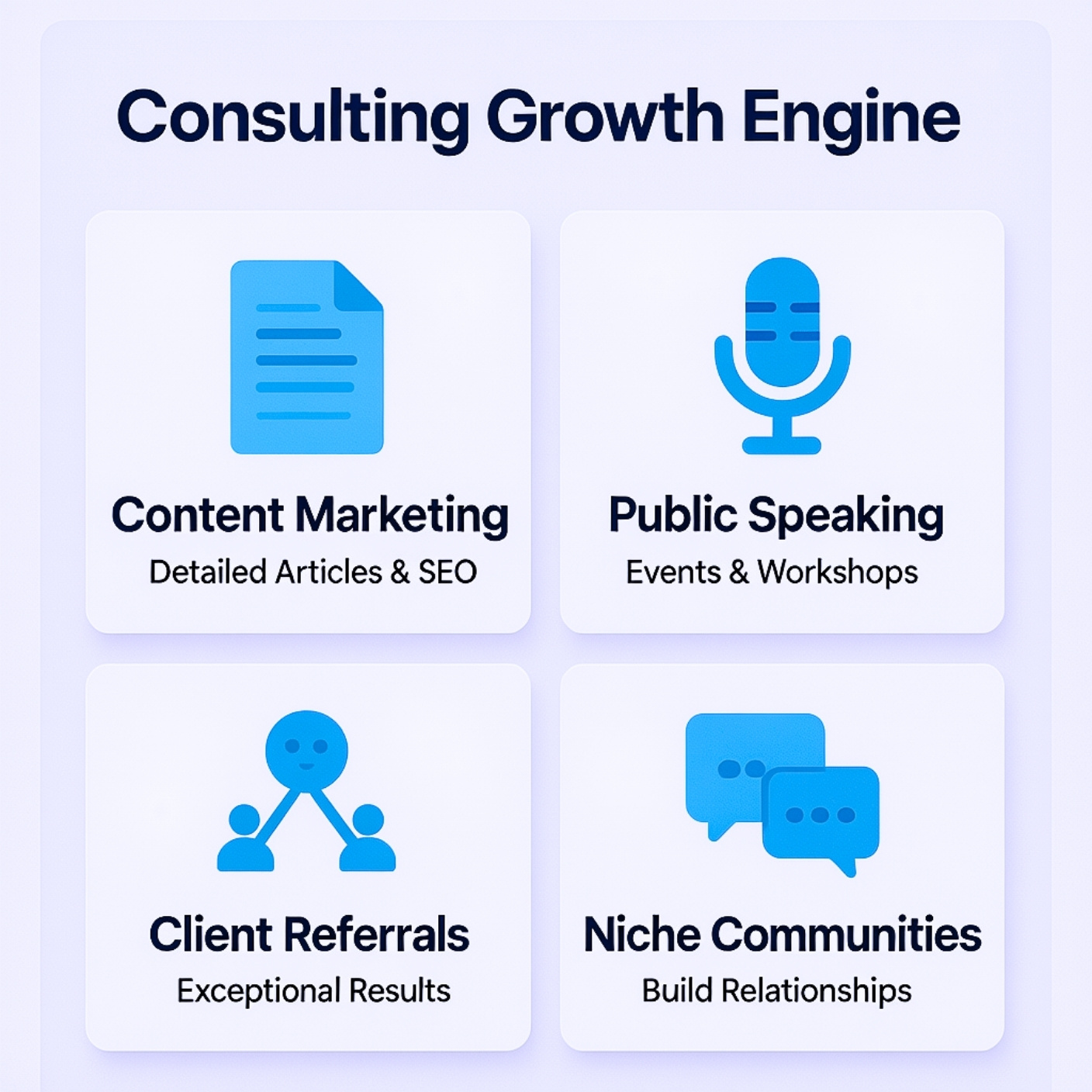
Small business clients rarely find consultants through cold outreach. They find you through referrals, content, speaking, and niche communities.
Content marketing works exceptionally well for consulting. Write detailed articles solving specific problems your ideal clients face. Publish case studies showing real results. Share frameworks and insights that demonstrate expertise. SEO brings qualified prospects actively searching for solutions.
Speaking at industry events and virtual conferences positions you as an authority. Even small local events provide credibility and direct access to potential clients. Offer actionable workshops rather than generic presentations. Attendees who implement your advice often return for deeper engagement.
Referrals from satisfied clients generate the highest quality leads. Build referral momentum by delivering exceptional results, staying in touch after projects end, and directly asking happy clients to introduce you to peers facing similar challenges.
Niche online communities where your ideal clients gather provide direct access without competing against thousands of other freelancers. Join Slack groups, forums, and Facebook communities. Contribute genuinely helpful insights without pitching. Build relationships over time. Opportunities emerge naturally.
Delivering Results That Generate Referrals
The best marketing is great work. Consulting projects that deliver measurable improvements create momentum through word-of-mouth and repeat business.
Set clear success metrics at project start. Define what success looks like in specific, measurable terms. Track progress visibly throughout the engagement. Celebrate wins with clients as they happen.
Communicate proactively. Small business owners appreciate transparency and regular updates. Weekly check-ins prevent surprises and build trust. Document decisions and share progress in writing so everyone stays aligned.
Train client teams thoroughly on any systems you implement. Adoption determines results. If the team doesn’t use the tools or follow the processes, outcomes suffer regardless of technical quality. Invest time in training, documentation, and change management.
Follow up after project completion. Check in at 30, 60, and 90 days to ensure sustained results and address any emerging issues. This demonstrates genuine care for outcomes rather than just closing deals. It also creates opportunities to identify additional work.
Scaling Your Consulting Practice
Most consultants hit a ceiling around $150,000 to $200,000 annual revenue because they try scaling by working more hours. The path forward requires leverage through productization, team, or hybrid models.
Productize common deliverables into repeatable processes. Standardize audit frameworks, implementation checklists, and training materials. Repetition improves quality while reducing delivery time. What takes 40 hours the first time might take 20 hours by the tenth iteration.
Some consultants transition successful consulting offers into white label AI solutions for freelancers, packaging their methodology and tools for other freelancers to resell. This creates leverage beyond direct client work while maintaining consulting as the core business.
Your consulting practice can evolve from solo work to a sustainable business model generating consistent high-value revenue. The key is positioning clearly, packaging offers intelligently, and delivering results that speak for themselves.