In the dynamic world of freelancing, a well-thought-out content strategy is essential for building your brand identity, attracting new clients, and maintaining audience engagement. An effective content strategy doesn’t simply produce content; it aims to achieve specific objectives and provide value to your audience. In this article, we’ll explore how to develop an optimized content strategy to maximize your impact.

Table of Contents
ToggleWhat is a content strategy?
A content strategy is the set of digital marketing actions aimed at planning the creation, distribution, and management of useful and informative content on one or more topics. These actions are designed for your communication channels, with the goal of expanding your audience, building trust and authority, and establishing lasting relationships with your customers.
A content strategy includes actions such as planning, promotion, design, management, and evaluation, which are implemented through tactics such as social media posts, blogs, ebooks, email marketing, videos, landing pages, podcasts, and any other written or audiovisual media.
Why is a content strategy essentia ?
- Direction and Clarity : A content strategy provides a clear roadmap of what you want to accomplish. Without direction, it’s easy to lose your way and produce content that doesn’t meet your objectives or your audience’s expectations.
- Consistency : A solid strategy ensures you remain consistent in your message, tone, and style. Consistency is crucial for strengthening brand recognition and maintaining your audience’s interest.
- Efficiency : Having a strategy in place helps you optimize your time and resources. You can plan ahead, which reduces the stress of last-minute content generation.
- Measurability : With a defined strategy, it’s easier to measure your success. You can determine what works, what doesn’t, and adjust your approach accordingly.
Elements of an effective content strategy
When developing a content plan, certain elements are essential. Each contributes to forging a unique identity for your business, making your brand more memorable and your content both engaging and useful for your current and potential customers.
Here are the content strategy elements to keep in mind:
1. Audience
The audience refers to the group of people toward whom all actions of your content strategy will be directed; this includes both your current customers and those you wish to attract.
The audience is composed of one or more buyer personas—a profile of your ideal customer created from fictional characteristics that help understand customer needs, frustrations, consumption habits, and demographics.
2. Brand storytelling
Brand storytelling is the summary of a brand’s history, its mission and vision, its values and personality.
Storytelling will help you define the messages to convey, how to communicate with your customers, and what content to create. It will ensure consistency in your communication across all channels, helping to strengthen your brand image. Ultimately, it will be the thread that enables your content strategy to achieve its objectives.
You must ensure that your brand story is:
- Realistic: No false promises or epic stories that never happened. Allow your customers to identify with what happens to them!
- Authentic: This stands out from others and, at the same time, reveals your true personality.
- Empathetic: You must include your customers in the story, make them feel part of it.
- Captivating: This elicits a reaction from everyone who encounters you! Identify the emotions you want to evoke and find ways to express them.
- Convincing: Give your audience a reason to choose you.
- Relevant: Demonstrates clear benefits and solutions that address your customers’ real needs.
3. Sales funnel
The sales funnel (also called sales pipeline or customer journey) is a visual representation of the process a customer follows in their relationship with a brand or product, from initial awareness to purchase. It is represented as follows:
All actions in your content marketing strategy must be guided by these stages, so that each represents a set of your customers’ needs.
For example, someone discovering your brand will likely need more information about it and its products, while someone considering purchasing from you will need to know what differentiates you from the competition.
However, there is also the flywheel model, a new model of the customer journey. In this model, conversion can occur at any stage of the process, and in different ways.
4. Content
Content is the essence of any strategy: it is the set of concrete actions your brand will take to attract customers and interact with them.
It can serve to inform, educate, motivate, or interact. Thus, a blog post is primarily educational (it develops new skills), while an ebook is interactive (it encourages the user to download it).
When developing it, make sure you have a content plan: a guide that defines the objectives of each action, the goals to achieve, and the metrics that will determine its success.
7 Steps to create a content strategy
1. Define goals and objectives
Before undertaking any business initiative, you must clearly define your goals and objectives. These should align with your company’s mission and values.
Possible objectives include:
- Building brand awareness
- Repositioning your brand to better communicate with consumers
- Increasing trust and authority
- Educating customers to improve their experience
- Embracing digital innovation in marketing
- Generating leads, sales, and revenue
- Improving customer retention
Identify key performance indicators (KPIs) that align with your objectives, evaluate your current performance, and track progress throughout the implementation of your strategy. This data will enable you to make informed, results-driven adjustments.
2. Identify your target audience
A company’s target audience is the group of consumers most likely to be interested in its products or services, and whom its content must reach.
By understanding who they are, the challenges they face, and what motivates them, you can create content that truly resonates with them.
Consider key factors such as:
- Demographics: age, gender, occupation, income, lifestyle
- Behavior: website browsing habits, email open rates, purchase history
- Motivations: Primary reasons for purchase decisions
If you’re targeting multiple audiences, tailor your content strategy to each group by addressing their specific needs and preferred channels.
3. Generate topics and conduct keyword research
Once you understand your audience, brainstorm topics that align with their interests and your business objectives.
In his book “Digital Marketing Strategy,” Gupta recommends focusing on customer pain points—the problems your product or service helps solve. These pain points often correspond to keywords your audience searches for, making them essential for search engine optimization (SEO) and organic traffic growth.
Next, think about how to approach these topics from an original angle. Differentiate your content by offering fresh ideas or distinct perspectives.
“Don’t forget that your competitors are also trying to attract your target customers,” Gupta explains in Digital Marketing Strategy. “Therefore, your content must highlight your unique value proposition. This is the opportunity to convince potential customers to consider your product.”
4. Select content types and formats
Historically, most digital marketers focused on blog articles and ebooks. While these formats remain valuable, today’s content landscape is far more diverse. Videos, whether short-form or long-form, are essential for social media visibility, while podcasts continue to grow in popularity.
“Content can take the form of a blog post, a description on your website, a video, a podcast, an image, or a testimonial,” Gupta explains in Digital Marketing Strategy. “There are many options. The choice depends on which format best allows you to tell your story and is most suitable for your target clientele.”
Choose your audience’s preferred formats, determine the level of detail needed for each piece of content, and ensure compatibility with your distribution channels. Most strategies should combine different formats for greater visibility.
5. Develop a content calendar
An editorial calendar helps you organize and track your efforts, especially when multiple people contribute to creating, publishing, and promoting content.
Include details such as:
- Content titles, topics, or target keywords
- Format and channels
- Roles and responsibilities
- Key milestones, such as drafts, revisions, and publication dates
- Target audience segments
- Supporting products or initiatives
A simple spreadsheet may suffice, but many project management tools offer collaborative content calendar features and social media integration. Choose the option that best matches your workflow.
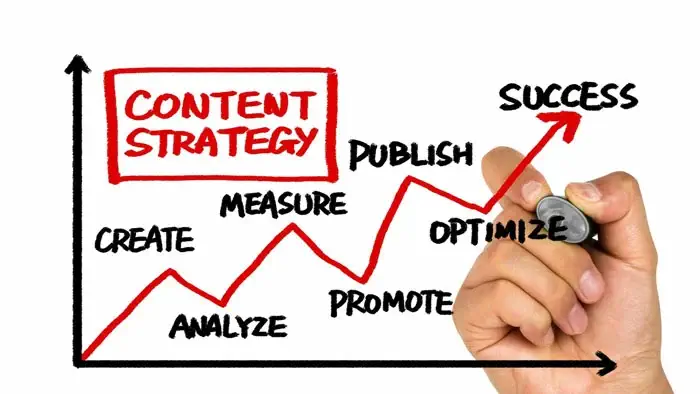
6. Create, publish, and distribute content
Once your content is ready, distribute it where your target audience will find it. As Gupta emphasizes in “Digital Marketing Strategy,” many channels are available, including your company website, your YouTube channel, or other media you own.
Start with your own platforms (your website or email newsletter) where you maintain control, and follow SEO best practices to ensure your content is discoverable by search engines and users.
Your omnichannel marketing strategy ensures a consistent brand experience across all channels, online and offline, including paid marketing activities and public relations. Clearly define the steps and responsibilities related to creating and distributing this content to ensure consistency across all channels with your digital strategy.
After publication, also consider distributing your content on other platforms where your target audience is active, such as:
- Social media platforms: Facebook, Instagram, TikTok, LinkedIn, Threads, X
- Video or live streaming platforms: YouTube, Vimeo, Twitch
- Forums: Reddit, Quora, Stack Overflow
- Affiliate activities: guest posts, site takeovers, podcasts
7. Track performance and optimize
Even the most polished content doesn’t always produce the expected results. That’s why it’s essential to track content performance and make data-driven modifications.
Use analytics tools to measure your results. Many platforms, such as your content management systems (CMS) or social networks, offer built-in analytics features. Other available tools include Google Analytics, HubSpot, Semrush, Ahrefs, and Hotjar.
Choose metrics relevant to your objectives, such as monthly views, downloads, or clicks. Use this data to refine your future content and improve your overall strategy.