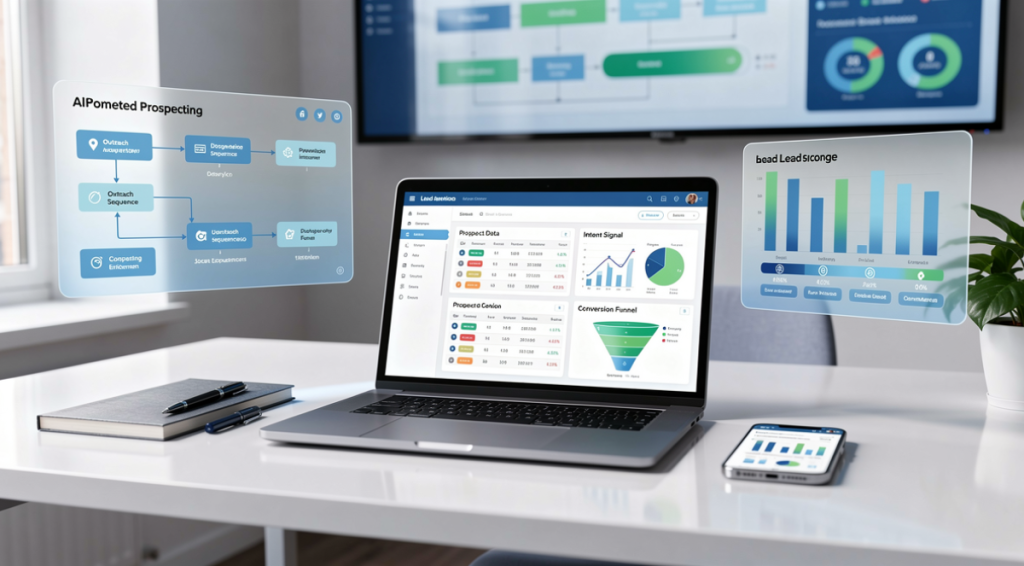
Sales and marketing teams waste enormous resources pursuing prospects who will never convert. Without data-driven prioritization, every lead receives similar attention regardless of actual potential. Predictive analytics uses AI to score prospects based on likelihood to convert, lifetime value potential, and optimal engagement timing. This intelligence allows you to focus expensive human resources on opportunities worth pursuing while automating or deprioritizing unlikely conversions. The financial impact of better targeting compounds quickly as your team closes more deals with the same effort. This analytical approach integrates with the broader strategies covered in our comprehensive overview of growth hacking with AI to acquire customers.
The challenge every sales team faces is resource allocation. You have limited time and budget to pursue opportunities. Treating all leads equally means spreading resources too thin and missing high-value prospects while chasing dead ends. Intuition and experience help prioritize, but subjective judgment misses patterns hidden in data.
How predictive analytics transforms lead qualification
Traditional lead scoring assigns points based on simple criteria like job title, company size, or actions taken. A director gets more points than a manager. A large company scores higher than a small one. Downloaded a whitepaper adds five points. This manual scoring requires constant updating and often correlates poorly with actual conversion.
Predictive lead scoring uses machine learning to analyze thousands of variables simultaneously. The AI examines your historical data to identify which combinations of attributes and behaviors actually predict conversion. It might discover that prospects from specific industries who engage with particular content types within certain timeframes convert at exponentially higher rates.
The model continuously learns and adapts as new data arrives. When market conditions change or your product evolves, the predictive algorithm adjusts automatically. Traditional scoring rules remain static until someone manually updates them, becoming increasingly inaccurate over time.
Prediction confidence scores accompany each lead rating. The AI indicates not just that a lead is high-value but how confident that prediction is based on available data. This transparency helps sales teams make informed decisions about which predictions to trust versus which need additional validation.
Key variables that predict customer conversion
Firmographic data provides the foundation for B2B predictions. Company size, industry, revenue, growth rate, geographic location, and technology usage all correlate with purchase probability. The AI identifies which firmographic combinations indicate ideal fit for your specific solution.
Behavioral signals often predict conversion better than static attributes. Engagement frequency, content consumption patterns, email responsiveness, website return visits, and social media interactions all reveal buying intent. Someone visiting your pricing page three times in two days shows stronger intent than someone with perfect firmographics who visited once months ago.
Technographic data indicates what technologies prospects currently use. Companies using complementary or competitive solutions to yours represent different opportunity types. The AI might learn that companies using certain CRM platforms convert well while those using others rarely do, revealing integration compatibility or competitive displacement challenges.
Temporal patterns identify optimal engagement timing. Prospects often show predictable behavior sequences before converting. They might research for two weeks, engage intensely for three days, then go silent for a week before making decisions. Recognizing these patterns allows timing outreach for maximum receptivity.
Network effects and relationship data improve predictions substantially. Prospects connected to existing customers or located in geographic clusters where you have strong presence convert more readily. The AI incorporates these relationship variables that humans often overlook in individual prospect evaluations.
Implementing predictive lead scoring systems
Building effective predictive models requires sufficient historical data. Most platforms need at least several hundred closed deals to train algorithms reliably. Smaller datasets produce unstable models that overfit to noise rather than identifying genuine patterns. Companies without adequate data should start with traditional scoring while collecting information for future predictive models.
Data quality determines model accuracy more than algorithm sophistication. Incomplete records, duplicate entries, inconsistent categorization, and missing outcome data all degrade predictions. Cleaning your CRM data before implementing predictive analytics delivers better results than running advanced algorithms on messy data.
Feature engineering helps models identify relevant patterns. Rather than feeding raw data to algorithms, thoughtful preparation improves results. Creating derived variables like engagement velocity, content preference categories, or buying stage indicators helps AI find meaningful relationships faster and more accurately.
Model validation prevents overconfidence in predictions. Reserve a portion of historical data for testing rather than training. The model makes predictions on this holdout set and you measure accuracy. This validation reveals whether predictions will work on new leads or only fit historical data coincidentally.
Integration with existing workflows ensures predictions actually influence decisions. Scores displayed in your CRM help sales prioritize outreach. High-value predictions trigger automated nurture sequences in marketing automation platforms. Low-score leads route to lower-touch channels rather than expensive direct sales efforts.
Predicting customer lifetime value
Conversion probability represents only part of opportunity assessment. A prospect likely to convert but purchase the smallest package differs significantly from one equally likely to convert who will spend ten times more. Lifetime value predictions help prioritize not just who will buy but who will deliver the most revenue.
CLV models consider initial purchase size, expansion potential, retention likelihood, and referral probability. Historical customer data trains algorithms to identify which prospect attributes correlate with each value component. The AI might discover that certain industries expand aggressively while others remain static, or that company size predicts retention better than purchase amount.
Product mix predictions estimate which offerings prospects will purchase. Knowing a prospect will likely buy your premium tier plus three add-ons differs from predicting they will choose the basic package. This granular insight allows more accurate revenue forecasting and appropriate sales resource allocation.
Expansion opportunity scoring identifies which customers will grow spending over time. Some customers start small but expand dramatically. Others make large initial purchases but never expand. Recognizing expansion potential early allows strategic relationship investment that pays off through account growth.
Churn risk predictions identify customers likely to cancel or reduce spending. Early detection allows proactive retention efforts before problems escalate. The AI spots warning signs like decreased usage, support ticket patterns, or engagement drops that predict churn months before it happens.
Using predictive insights strategically
Sales territory assignment improves with predictive data. Rather than distributing leads geographically or alphabetically, assign high-value predictions to your strongest closers. Less experienced reps receive lower-score leads for practice without risking major opportunities. This strategic allocation maximizes conversion rates across the entire team.
Marketing spend optimization targets campaigns toward audiences with highest predicted conversion and lifetime value. Rather than equal budget allocation across channels or segments, concentrate investment where ROI will be strongest. The AI identifies which acquisition sources produce the most valuable customers, informing strategic budget decisions.
Pricing strategy benefits from value predictions. Prospects predicted to have high lifetime value might receive more aggressive discount offers because acquisition cost justifies higher upfront investment. Low-value predictions receive standard pricing without margin erosion. This dynamic pricing maximizes profit without leaving money on the table.
Content and messaging personalization reaches next level effectiveness when guided by predictive insights. Understanding not just who prospects are but how likely they are to convert and what value they represent allows tailoring communication strategies. High-value predictions receive white-glove treatment while low-scores get efficient automated nurturing.
Product development priorities shift based on expansion predictions. Features that increase retention among high-value customer segments deserve more development resources than those appealing primarily to low-value segments. This value-informed roadmap maximizes revenue impact of product investments.
Top predictive analytics platforms
Salesforce Einstein integrates predictive scoring directly into the Salesforce ecosystem. It analyzes your Salesforce data automatically without additional configuration. The tight integration means predictions appear naturally in workflows sales teams already use. However, Salesforce licensing requirements make this an expensive option.
6sense specializes in B2B predictive analytics and intent data. The platform combines your first-party data with extensive third-party intent signals to predict which accounts are in-market. The AI identifies buying stage, likely purchase timing, and competitive threats. Enterprise B2B companies find 6sense particularly valuable for complex sales cycles.
InsideSales Playbooks uses predictive analytics to guide sales actions. Beyond scoring leads, it recommends specific next steps for each opportunity based on predictions about what actions will advance deals. This prescriptive approach helps less experienced reps apply sophisticated strategies consistently.
Infer provides standalone predictive lead scoring that integrates with major CRM and marketing automation platforms. It enriches your data with external sources and builds custom models for your specific business. The platform works well for mid-market companies wanting predictive capabilities without enterprise software complexity.
Custom models built with tools like Python’s scikit-learn or cloud ML platforms like Google AutoML provide maximum flexibility. Data science teams can engineer features specifically for your business, incorporate proprietary data sources, and optimize for your unique conversion patterns. This approach requires substantial technical expertise but delivers the most accurate predictions.
Avoiding common predictive analytics mistakes
Over-reliance on predictions without human judgment creates problems. Models identify patterns but do not understand context. A lead might score low due to unusual characteristics but actually represent a major opportunity. Sales teams should treat predictions as guidance rather than absolute truth.
Ignoring model limitations leads to poor decisions. All predictions include error rates. Understanding confidence intervals and accuracy metrics prevents treating uncertain predictions as facts. The best implementations communicate prediction confidence explicitly so users calibrate their trust appropriately.
Failing to update models as your business evolves degrades accuracy over time. As you enter new markets, launch products, or change positioning, the patterns predicting conversion shift. Regular model retraining on recent data maintains relevance. Most platforms handle this automatically, but custom models require ongoing maintenance.
Privacy and compliance considerations matter increasingly as regulations tighten. Predictive models that incorporate personal data must comply with GDPR, CCPA, and similar privacy laws. Ensure your implementation respects customer privacy preferences and provides required transparency about data usage.
For complementary strategies on engaging the high-value prospects you identify through predictive analytics, explore our guide on AI email marketing automation that improves engagement and conversion rates.
Related: Best AI tools for freelancers — our complete guide for freelancers.
Frequently Asked Questions
What is the best CRM for freelancers and small businesses?
The best CRMs for freelancers include HoneyBook (all-in-one for creative freelancers), HubSpot Free (powerful for lead management), and Notion (flexible for project-based work). For small businesses needing more power, Salesforce and Zoho CRM offer robust features with AI capabilities.
How can AI improve lead generation for freelancers?
AI improves lead generation by automating prospect research, personalizing outreach at scale, scoring leads based on conversion likelihood, and identifying the best time to follow up. Tools like Clay, Apollo.io, and HubSpot AI can reduce the time spent on manual prospecting by 60–70%.
What is client onboarding automation?
Client onboarding automation sends the right information to new clients at the right time — welcome emails, contract signing links, questionnaires, project kickoff documents, and payment instructions — all triggered automatically when a client signs a contract or pays an invoice.
How do I retain clients using AI tools?
AI tools help with client retention by automating check-in emails, tracking project milestones, generating personalized reports, and identifying at-risk clients before they churn. Consistent, proactive communication is the #1 factor in client retention.